NEET 2026 Syllabus Breakdown: What to Focus on First
What to Focus on First NEET 2026 is not just an entrance exam — it is a 720-mark test of how well you understand Biology, Physics, and Chemistry at the NCERT level. With over 24 lakh students appearing every year and only around 1 lakh MBBS seats available across India, smart prioritisation of the syllabus is what separates students who score 600+ from those who don’t. This guide breaks down every subject, chapter, and priority level so you know exactly where to invest your time first. 01. NEET 2026 — Exam at a Glance Before diving into the syllabus breakdown, here is a clear picture of the exam structure every BiPC student must know: 02. Subject-Wise Weightage — Where the Marks Come From Each subject carries equal weightage on paper (25% each), but Biology — split equally between Botany and Zoology — accounts for 50% of your total score. This single insight should drive your preparation strategy: Biology is your fastest route to a high NEET rank. “In NEET, Biology is your scoring engine. Master it first, deeply. Physics and Chemistry then become your rank boosters.”— Academic Team, Apeksha Jr. College 03. Biology — The Make-or-Break Subject (360 Marks) Biology is tested entirely from NCERT Class 11 and 12 textbooks. Every single line of NCERT Biology is potential exam material. Students who read NCERT thoroughly — diagrams, examples, and all — consistently score 330+ in Biology. Here are the must-focus chapters ranked by question frequency: Pro Tip: Read NCERT Biology word-for-word, not just chapter summaries. NEET frequently picks questions from side boxes, examples, and even diagram labels in the NCERT textbook. Do not skip any part of the text. 04. Physics — Build Concepts Before Speed (180 Marks) Physics in NEET is not as deep as JEE Main, but it still demands conceptual clarity and numerical accuracy. Most students lose marks here because they try to memorise formulas without understanding derivations. Focus on these chapters: Pro Tip: In NEET Physics, 60–70% of questions can be solved by applying formulas correctly to straightforward situations. Master the formula derivations first, then practise numerical application. Do not skip Modern Physics — it is consistently high yield. 05. Chemistry — The Silent Rank Booster (180 Marks) Chemistry in NEET is the most predictable and score-friendly subject if you follow NCERT diligently. Organic Chemistry consistently contributes the most questions. Physical Chemistry requires numerical practice, while Inorganic Chemistry rewards those who read every NCERT line carefully. Pro Tip: For Organic Chemistry, understand reaction mechanisms — not just products. For Inorganic (p-block, d-block, f-block), make structured one-page notes from NCERT. These chapters are memory-intensive but highly rewarding in NEET. 06. Recommended 10-Month Study Plan Here is a phase-wise preparation roadmap designed for students starting their NEET 2026 journey from Class 11 or the beginning of Class 12: 07. 7 Golden Rules for NEET Syllabus Mastery Crack NEET 2026 with Apeksha Jr. CollegeExpert BiPC coaching in Hyderabad — structured syllabus, daily tests, and personalised mentorship.Book a Free Counselling Session –> apekshaedu.in 08. Final Word — Start with What Matters Most The NEET 2026 syllabus is vast, but it is not unmanageable. The students who score 600+ are not those who covered everything — they are those who covered the right things deeply. Start with high-priority Biology chapters, build your Physics fundamentals, and make Chemistry your secret scoring weapon.At Apeksha Junior College, Kompally, Hyderabad, our BiPC + NEET programme is structured around exactly this framework — prioritised, NCERT-aligned, and mentored by experienced faculty who know the exam inside out. Visit apekshaedu.in to start your NEET 2026 journey with a plan that works.
Why Early Preparation is the Key to Success in IIT-JEE & NEET
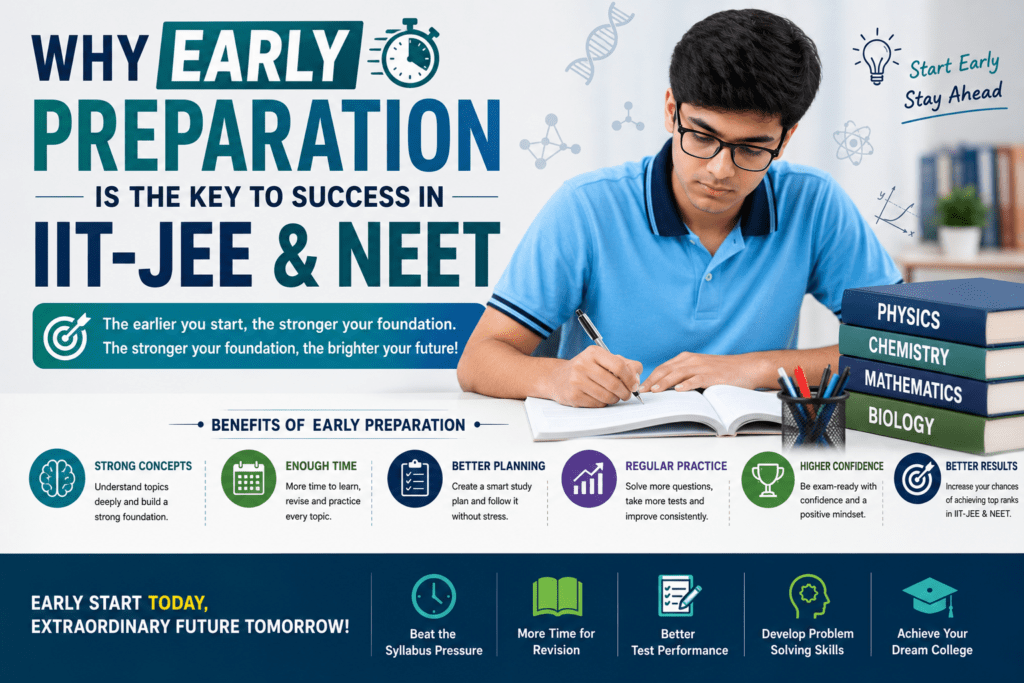
Cracking highly competitive exams like IIT-JEE and NEET requires more than just intelligence—it demands consistent effort, strong fundamentals, and strategic planning. One of the most crucial factors that determines success in these exams is starting early. Early preparation gives students a significant advantage, helping them build confidence, reduce stress, and improve their chances of success in the very first attempt. Strong Foundation from the Beginning Both IIT-JEE and NEET are concept-driven exams that test a student’s understanding rather than rote learning. Starting preparation early—right from the beginning of intermediate—allows students to build a strong foundation in core subjects like Physics, Chemistry, Mathematics, and Biology. Instead of rushing through topics, students get enough time to understand concepts deeply, which is essential for solving complex and application-based questions. More Time for Practice and Mastery Practice is the backbone of success in competitive exams. Early preparation provides ample time to practice different types of questions, including advanced-level problems and previous years’ papers. For JEE aspirants, this means mastering problem-solving techniques in Mathematics and Physics. For NEET aspirants, it involves strengthening accuracy and speed, especially in Biology and Chemistry. With more time in hand, students can gradually improve their performance without feeling pressured. Reduced Stress and Better Time Management Last-minute preparation often leads to stress, confusion, and burnout. Starting early helps students distribute their workload evenly over time, making preparation more manageable and less overwhelming. Students can create a balanced study schedule that includes: This structured approach leads to better time management and a healthier study routine. Effective Revision and Retention Revision plays a critical role in long-term memory retention. Early starters get the advantage of revisiting topics multiple times before the exam. This repeated revision helps in: Instead of cramming at the last moment, students can confidently revise and reinforce what they have already learned. Opportunity to Identify and Improve Weak Areas When students start early, they have enough time to analyze their strengths and weaknesses. Through regular tests and self-assessment, they can identify areas that need improvement. This allows them to: Such continuous improvement is key to achieving high scores in competitive exams. Better Performance in Both Boards and Entrance Exams Early preparation ensures that students are not just ready for entrance exams but also perform well in intermediate board exams. Since many topics overlap, preparing in advance helps students excel in both simultaneously. This integrated approach saves time and ensures a more efficient learning process. Builds Confidence and Exam Readiness Confidence is a major factor in competitive exams. Students who prepare early feel more confident because they are well-prepared and have practiced extensively. They are familiar with exam patterns, time constraints, and question types. This confidence helps them stay calm and perform better under pressure. The Smart Way Forward Early preparation is not about studying all the time—it’s about studying consistently and strategically. Even a few focused hours every day can make a huge difference over time. Students who start early develop discipline, clarity, and a strong academic mindset, all of which are essential for success in IIT-JEE and NEET. Conclusion Success in IIT-JEE and NEET is a combination of hard work, smart planning, and consistency. Starting early gives students the time and space to grow, learn, and excel without unnecessary pressure. If you aim to crack these exams in your first attempt, the best time to start is now. Early preparation doesn’t just improve your chances of success—it sets the foundation for a bright and successful future.
MPC vs BiPC: Which Stream is Right for Your Career Goals?

Choosing the right stream after 10th is one of the most important decisions in a student’s academic journey. For students stepping into intermediate education, the two most popular options are MPC (Maths, Physics, Chemistry) and BiPC (Biology, Physics, Chemistry). Each stream opens doors to different career paths, so understanding your interests, strengths, and long-term goals is essential before making a choice. Understanding MPC (Maths, Physics, Chemistry) MPC is the ideal stream for students who enjoy mathematics, logical reasoning, and problem-solving. This stream lays a strong foundation for careers in engineering, technology, and analytical fields. Career opportunities after MPC include: Students who are comfortable with numbers, formulas, and analytical thinking will thrive in MPC. It requires consistent practice, especially in mathematics and physics, but offers vast career opportunities in rapidly growing industries. Understanding BiPC (Biology, Physics, Chemistry) BiPC is best suited for students who are passionate about biology, healthcare, and life sciences. It focuses more on theoretical understanding, especially in biology, along with conceptual knowledge of physics and chemistry. Career opportunities after BiPC include: If you are interested in human anatomy, healthcare, and research, BiPC can be the right path. It requires strong memory skills, conceptual clarity, and dedication, especially for competitive exams like NEET. Key Differences Between MPC and BiPC How to Choose the Right Stream? Making the right choice depends on a few key factors: The Role of Integrated Coaching Whichever stream you choose, opting for integrated coaching can significantly improve your chances of success. Programs that combine intermediate education with JEE or NEET preparation help you stay focused, save time, and build strong concepts from the beginning. Conclusion There is no “better” stream between MPC and BiPC—only the one that’s right for you. Your choice should align with your passion, strengths, and long-term vision. Take time to evaluate your interests, seek guidance from mentors, and make an informed decision. Remember, success doesn’t depend on the stream you choose, but on how dedicated and consistent you are in pursuing your goals.
How Integrated Coaching Helps Students Crack JEE & NEET in the First Attempt

Cracking competitive exams like JEE and NEET in the first attempt is a dream for many students—and with the right approach, it’s absolutely achievable. One of the most effective methods gaining popularity today is integrated coaching, where intermediate education and entrance exam preparation go hand-in-hand. This approach is especially powerful for students enrolled in MPC (Maths, Physics, Chemistry) with JEE coaching and BiPC (Biology, Physics, Chemistry) with NEET coaching programs. What is Integrated Coaching? Integrated coaching combines board syllabus learning with focused preparation for competitive exams like JEE and NEET. Instead of treating them as separate goals, both are aligned into a single, structured learning system. This means students don’t have to juggle between college classes and external coaching centers—everything is streamlined under one program. Perfect Synchronization of Syllabus One of the biggest advantages of integrated coaching is syllabus synchronization. Topics taught in intermediate classes are directly linked to JEE or NEET concepts. For example, when a student learns organic chemistry in class, they simultaneously practice entrance-level questions on the same topic. This eliminates confusion, reduces repetition, and strengthens conceptual clarity—making learning more efficient and impactful. Strong Foundation for MPC + JEE Students For MPC students aiming for JEE, integrated coaching ensures a deep understanding of Physics, Chemistry, and Mathematics from the very beginning. Concepts are not just taught for board exams but are expanded to match the analytical level required for JEE. Students benefit from: This continuous exposure builds confidence and improves accuracy, which is crucial for cracking JEE in the first attempt. Focused Preparation for BiPC + NEET Aspirants For BiPC students preparing for NEET, integrated coaching emphasizes concept clarity and retention, especially in Biology, which carries the highest weightage. Key benefits include: By aligning intermediate syllabus with NEET requirements, students are better prepared to handle objective-based questions with speed and precision. Time Efficiency and Reduced Stress One of the major challenges students face is managing time between college studies and coaching classes. Integrated programs solve this by saving time and reducing academic pressure. Students can: This balanced routine leads to better mental focus and overall performance. Continuous Assessment and Performance Tracking Integrated coaching programs include regular tests, mock exams, and performance analysis. These assessments help students identify their strengths and weaknesses early on. With consistent feedback: Expert Guidance and Mentorship Another key advantage is access to experienced faculty who specialize in both board and entrance exam preparation. Students receive: This mentorship plays a crucial role in keeping students motivated and on track. The Winning Edge Integrated coaching creates a focused, disciplined, and result-oriented learning environment. By combining academics with competitive preparation, students develop the right mindset, skills, and confidence needed to succeed. For students pursuing MPC with JEE or BiPC with NEET, this approach offers a clear advantage—making it easier to crack these highly competitive exams in the very first attempt. ConclusionSuccess in JEE and NEET is not just about hard work—it’s about smart preparation. Integrated coaching provides the perfect blend of both, helping students stay ahead, stay confident, and achieve their goals without unnecessary stress.