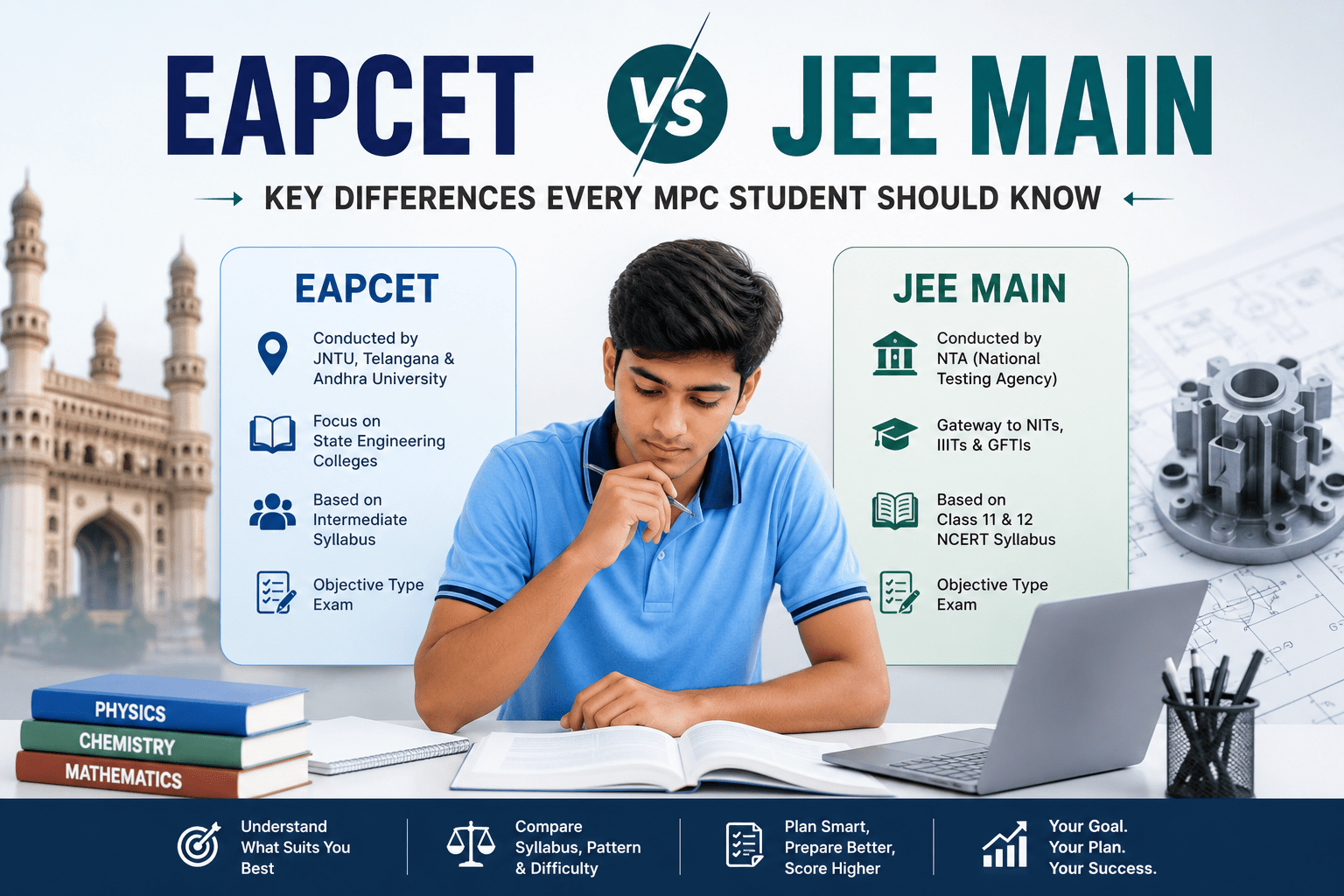
Every year, thousands of students across Hyderabad and Telangana face the same daunting challenge — excelling in Intermediate board exams while simultaneously preparing for JEE or NEET. Most assume it’s a trade-off. At Apeksha Junior College, we believe — and prove — that it isn’t. With the right strategy, you can nail both.
| 90%+BOARD SCORE TARGET | 70%SYLLABUS OVERLAP (JEE/BOARD) | 2 YearsTO MASTER BOTH |
01. Understand the Overlap — Stop Studying Twice
The single biggest mistake students make is treating board preparation and JEE/NEET preparation as completely separate journeys. They are not.
Over 70% of the JEE Main and NEET syllabus is directly aligned with the Intermediate MPC/BiPC curriculum. If you deeply understand Physics, Chemistry, Mathematics (or Biology), you’re simultaneously building your board foundation and competitive exam readiness. The key is to study concepts deeply rather than shallowly memorising two different sets of notes.
Subject Overlap Matrix
| [Common] Physics→ Mechanics & Laws of Motion→ Electrostatics & Current→ Waves & Optics→ Modern Physics | [Common] Chemistry→ Atomic Structure & Bonding→ Thermodynamics→ Organic Reactions→ Equilibrium |
| [JEE] Mathematics→ Calculus & Integration→ Coordinate Geometry→ Algebra & Sequences→ Probability | [NEET] Biology→ Cell Biology & Genetics→ Human Physiology→ Plant Physiology→ Ecology & Evolution |
02. Build a Realistic, Integrated Daily Schedule
Time management is the backbone of dual preparation. Here’s a sample daily routine that Apeksha students follow — designed to cover both board and competitive exam needs without burning out.
| TIME | ACTIVITY | FOCUS |
| 5:30 – 7:00 AM | Self-study (Difficult topics) | JEE/NEET |
| 7:00 – 8:00 AM | Morning revision & formula recall | Board |
| 8:30 AM – 2:30 PM | College classes (integrated) | JEE/NEET + Board |
| 3:00 – 4:00 PM | Rest / Light reading | Recovery |
| 4:00 – 6:00 PM | Problem-solving practice | JEE/NEET |
| 6:00 – 8:00 PM | Board-specific writing practice | Board |
| 8:30 – 9:30 PM | Daily test / MCQ review | JEE/NEET |
| 9:30 – 10:00 PM | Plan next day & wind down | Routine |
Note: Adjust this to suit your natural rhythm. Night owls can shift blocks later. What matters is consistency — not the exact timing.
03. Master the Art of Answering Board Questions
Board examiners reward presentation, structure, and clarity — not just correct answers. JEE/NEET-focused students often under-score in boards because they write fragmented, point-form answers where evaluators expect well-developed paragraphs with diagrams and derivations.
- Write derivations step-by-step — Even if you know the shortcut, show every step. Board marks are awarded at each stage of the working.
- Draw neat, labelled diagrams — Diagrams in Physics and Biology fetch dedicated marks. Keep them clean, large, and fully labelled.
- Practise previous year board papers — Solve the last 5 years of TS/AP Intermediate papers under timed conditions monthly.
- Underline key terms in answers — Evaluators scan answers quickly. Underline definitions, formula names, and important phrases.
04. Prioritise Topics Strategically — Use the 80/20 Rule
You cannot give equal time to every topic. The Pareto Principle applies here: roughly 20% of topics account for 80% of marks in both boards and competitive exams. Identify these high-yield areas and invest disproportionately in them.
| “Boards test breadth; competitive exams test depth. Your goal is to go deep on shared topics and cover board-exclusive topics efficiently in the last 60 days.”— Academic Strategy, Apeksha Jr. College |
- High-priority chapters first — In JEE: Mechanics, Electrostatics, Organic Chemistry, Calculus. In NEET: Genetics, Human Physiology, Organic Chemistry, Ecology. These are also board heavyweights.
- Board-only topics in sprint mode — Chapters that appear only in boards should be tackled in focused 2-hour sprints near the board exam. Don’t crowd your JEE/NEET schedule with them early.
05. Dos and Don’ts of Dual Preparation
| DO THIS Maintain a single, unified notebook per subject Revise board chapters every weekend Take at least one full board mock monthly Sleep 7-8 hours — memory consolidation depends on it Discuss doubts with teachers the same day Track weak topics in a dedicated log | AVOID THIS Ignore boards until 3 months before exams Maintain separate notes for board and JEE/NEET Skip college tests because they don’t count Study 14+ hours — quality beats quantity Neglect English/Telugu language papers Compare your progress with peers daily |
06. Leverage Mock Tests and Performance Analytics
What gets measured gets improved. Regular mock tests — both board-pattern and MCQ-based — give you two critical advantages: they reveal your weak zones before the actual exam, and they train you to perform under timed, exam-like pressure.
- Weekly subject tests — Short 30-minute tests on recent topics keep knowledge fresh and identify gaps before they become problems.
- Monthly full-length mocks — Simulate real exam conditions — same duration, no phone, no breaks. Analyse results to create a targeted revision list.
- Track accuracy, not just scores — A student who attempts 60 questions with 85% accuracy outperforms one who attempts 90 with 60% accuracy.
07. Mentorship Makes the Difference
Information is abundant. Personalised guidance is rare. The difference between a student who scores 75% and one who scores 90%+ often isn’t intelligence — it’s the quality of mentorship they receive.
At Apeksha Junior College, every student gets regular one-on-one mentoring sessions, personalised academic plans, and access to faculty who understand both the TS/AP Intermediate board pattern and the intricacies of JEE and NEET. This is our integrated model — and it works.
| “Education at Apeksha goes beyond marks. We prepare students for clarity, confidence, and a clear path to success — whether it’s an IIT, NEET rank, or EAPCET score.”— Mahadev Mundey, Founder & Director, Apeksha Jr. College |
| Ready to Score 90%+ While Acing JEE or NEET?Join Apeksha Junior College’s integrated MPC + JEE or BiPC + NEET programme in Hyderabad.Book a Free Counselling Session → apekshaedu.in/contact |
08. Final Takeaway: Dual Success Is Not a Myth
Scoring 90%+ in Intermediate board exams while clearing JEE or NEET is not about working harder — it’s about working smarter. Align your preparation, master the overlap, practise board-style writing, and seek mentored guidance.
The students who excel at both are not superhuman. They are focused, consistent, and — more often than not — guided by an institution that understands how to bridge academic and competitive success. At Apeksha Junior College, Kompally, Hyderabad, that is exactly what we do — every single day.