
If you are an MPC student in Telangana or Andhra Pradesh, two exams define your engineering future: EAPCET and JEE Main. While both test Physics, Chemistry, and Mathematics, they differ significantly in structure, difficulty, marking scheme, and the doors they open. Understanding these differences early can help you allocate your preparation time wisely — and avoid the costly mistake of treating them as the same exam.

01. What Is EAPCET?
EAPCET (Engineering, Agriculture & Pharmacy Common Entrance Test) is conducted by JNTU Hyderabad on behalf of the Telangana State Council of Higher Education (TSCHE). It is the gateway exam for admission to B.Tech, B.Pharmacy, and Agriculture programs in government and private colleges across Telangana and Andhra Pradesh.
The exam is based on the TS/AP Intermediate MPC syllabus, making it very closely aligned with what you study in Class 11 and 12 at your junior college. This is a significant advantage for students who attend local Intermediate colleges — your board syllabus and EAPCET syllabus are essentially the same.
02. What Is JEE Main?
JEE Main (Joint Entrance Examination — Main) is conducted by the National Testing Agency (NTA) and is the primary gateway to NITs, IIITs, and Government Funded Technical Institutions (GFTIs) across India. Clearing JEE Main with a good score and percentile also makes you eligible to appear for JEE Advanced — the entrance to the IITs.
JEE Main is based on the NCERT Class 11 and 12 syllabus and is significantly more competitive, with over 12 lakh students appearing annually. It is offered twice a year, and your best percentile across sessions is considered for admission.
03. Head-to-Head Comparison
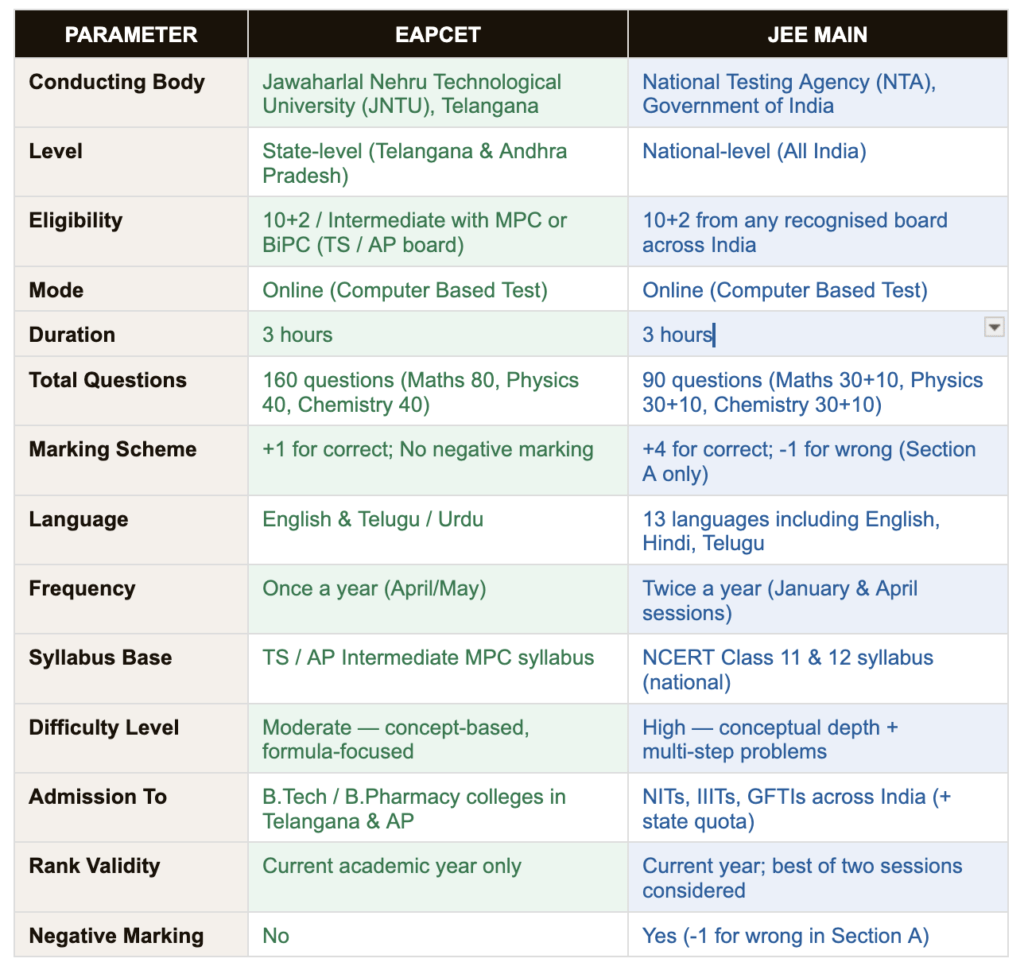
The table below captures every major difference between the two exams at a glance:
04. Key Differences That Change Your Strategy
Marking Scheme: EAPCET carries no negative marking, which means you should always attempt every question — even when unsure. JEE Main deducts 1 mark for every wrong answer in Section A, so guess-work must be calculated and strategic.
Syllabus Depth: EAPCET strictly follows the TS/AP Intermediate syllabus. JEE Main follows NCERT, which includes certain topics and problem types not covered in the state board syllabus. Students preparing for JEE Main must go beyond their Intermediate textbooks.
Difficulty Level: EAPCET questions are moderate in difficulty — they test conceptual clarity and formula application. JEE Main questions are harder, often involving multiple steps, concept integration, and higher-order thinking. Scoring 90%+ in EAPCET is realistic for consistent students; a 90 percentile in JEE Main demands significantly more rigour.
Frequency: JEE Main is conducted twice a year, giving you a second chance to improve. EAPCET is held only once. This means JEE Main strategy can involve using Session 1 as a diagnostic test and Session 2 as the actual performance attempt.
Question Count: EAPCET has 160 questions in 3 hours — a tighter pace of roughly 67 seconds per question. JEE Main has 90 questions in 3 hours, giving you about 2 minutes per question, but each question demands deeper analysis.
| “Preparing seriously for JEE Main automatically strengthens your EAPCET performance. But the reverse is not always true — EAPCET preparation alone is rarely sufficient for JEE Main.”— Academic Team, Apeksha Jr. College |
05. Which Exam Should You Prioritise?
The answer depends entirely on your goals. Here is a simple framework:
- If your goal is admission to a top NIT, IIIT, or IIT — prioritise JEE Main (and JEE Advanced). EAPCET will take care of itself as a natural by-product of strong JEE preparation.
- If your goal is a seat in a reputed Telangana or AP engineering college — focus primarily on EAPCET while maintaining a working knowledge of JEE Main concepts.
- If you are aiming for both — an integrated coaching programme that covers both syllabi simultaneously is the most time-efficient path.
At Apeksha Junior College, our MPC programme is designed to prepare students for both EAPCET and JEE Main simultaneously — without doubling the study load. Our faculty understand where the syllabi overlap and where they diverge, allowing students to prepare smarter.
06. Quick Tips for Dual Preparation
- Cover NCERT thoroughly — it is the foundation for JEE Main and reinforces EAPCET concepts simultaneously.
- Practise EAPCET previous papers to build speed and accuracy for the 160-question format.
- For JEE Main, solve topic-wise question banks that go beyond the Intermediate textbook.
- Since EAPCET has no negative marking, maximise your attempt rate. For JEE Main, skip questions you are less than 60% confident about in Section A.
- Attend regular mock tests timed to both exam formats — the pacing strategies are different and need separate drilling.
| Prepare for EAPCET + JEE Main with Expert GuidanceJoin Apeksha Junior College, Kompally, Hyderabad — Integrated MPC coaching designed for both exams.Book a Free Counselling Session –> apekshaedu.in |
07. Final Word
EAPCET and JEE Main are not rivals — they are complementary milestones on the same MPC journey. Understanding their differences early allows you to prepare strategically rather than reactively. The students who crack both exams are not those who studied the most — they are those who prepared the smartest.At Apeksha Junior College, Kompally, Hyderabad, we help MPC students do exactly that — navigate both exams with clarity, confidence, and the right mentorship. Visit us at apekshaedu.in to learn more.